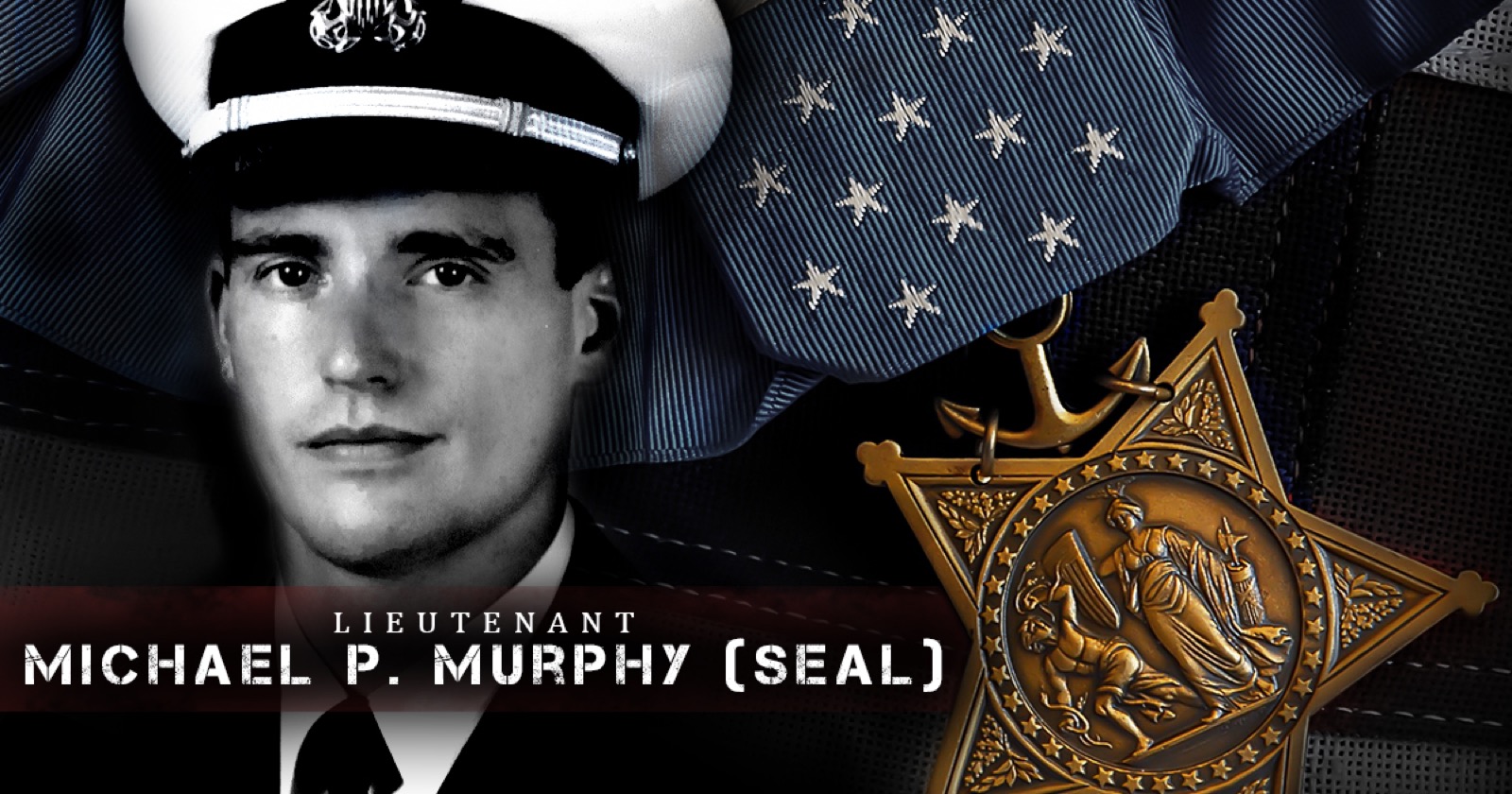
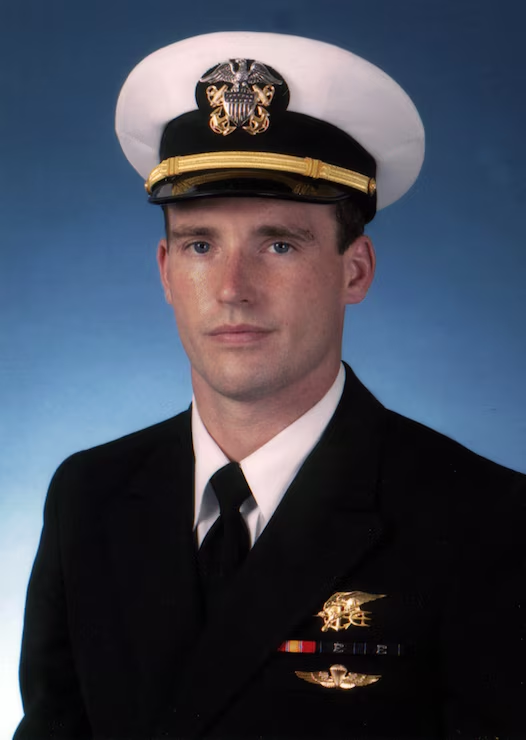
In memory of
Lt. Michael P. Murphy
United States Navy SEAL · Medal of Honor
May 7, 1976 – June 28, 2005
Why it's called "Murph"
Every time you run a mile, do 100 pull-ups, 200 push-ups, 300 squats and run another mile, you are doing one of Michael Murphy's favourite workouts. He called it "Body Armor" and did it in a 20 lb vest. After he was killed in action in Afghanistan, CrossFit published it as a Hero WOD in his name in August 2005. It has been done every Memorial Day since — the Murph Challenge — in his honour and the honour of everyone who fell alongside him.
The times you log here are your own small tribute. Go hard.
Who he was
Michael Patrick Murphy — "Murph" to friends and family — was born on May 7, 1976 in Smithtown, N.Y. and grew up in Patchogue on Long Island. He was active in sports from a young age and took a summer lifeguard job at the Brookhaven town beach in Lake Ronkonkoma, a job he returned to every summer through college.
At Penn State he was an exceptional all-round athlete and student, excelling at ice hockey and graduating with honours in 1998 with degrees in political science and psychology. He was an avid reader, from Herodotus to Tolstoy's War and Peace; his favourite book was Steven Pressfield's Gates of Fire, about the Spartan stand at Thermopylae.
Accepted to several law schools, he changed course instead. Slightly built at 5 ft 10 in, he attended SEAL mentoring sessions at the U.S. Merchant Marine Academy with his sights set on becoming a Navy SEAL. He was commissioned as an ensign on December 13, 2000 and began BUD/S in Coronado in January 2001, graduating with Class 236. After Army Jump School, SEAL Qualification Training and SDV school, he earned his Trident and joined SEAL Delivery Vehicle Team 1 in Pearl Harbor in July 2002.
He deployed to Jordan, Qatar in support of Operation Iraqi Freedom, and the Horn of Africa. In early 2005 he was assigned as assistant officer in charge of ALFA Platoon, SDVT-1, and deployed to Afghanistan in support of Operation Enduring Freedom.
Photos
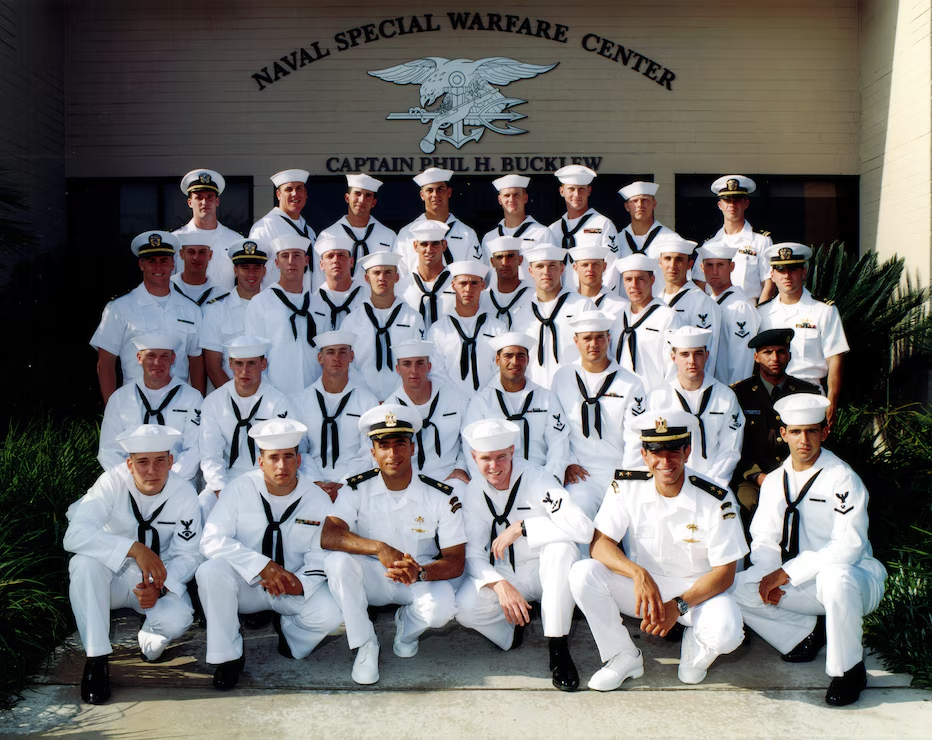
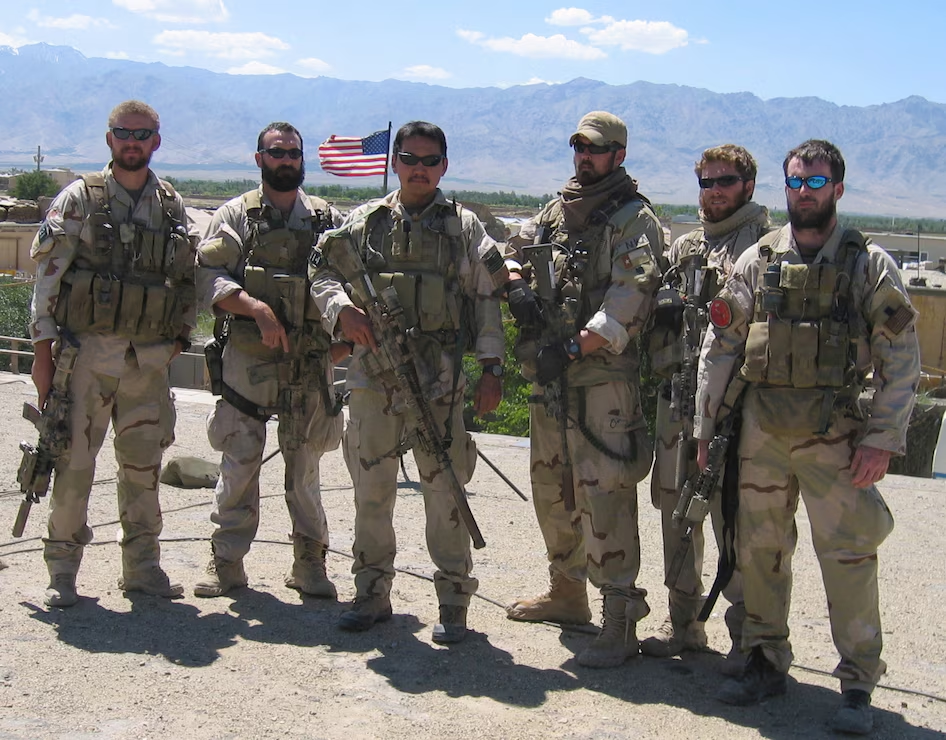
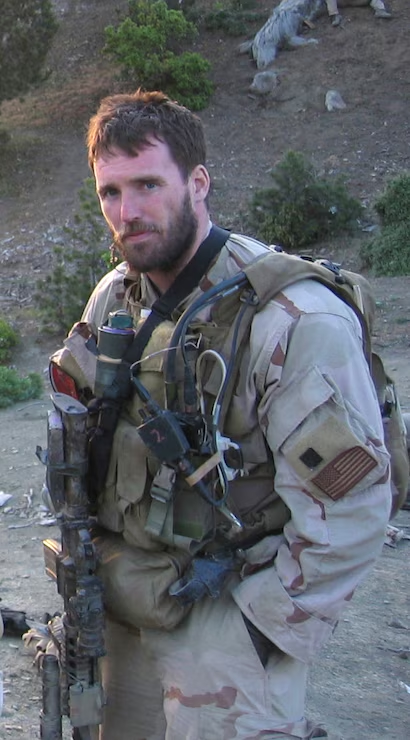
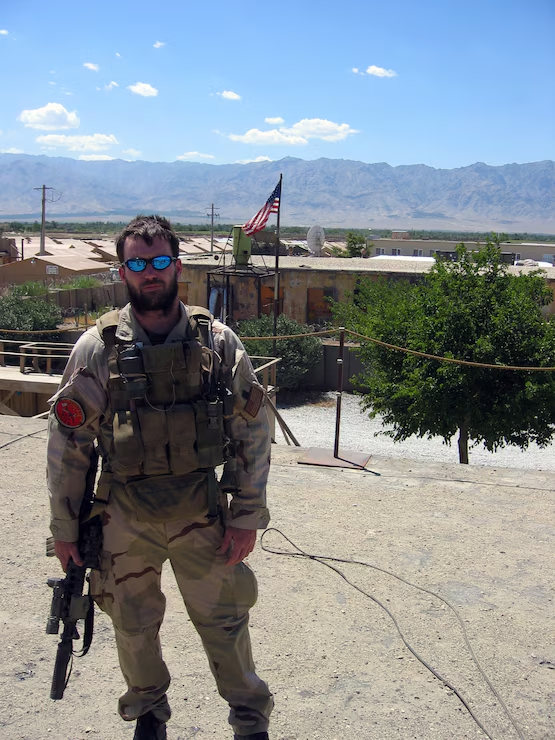
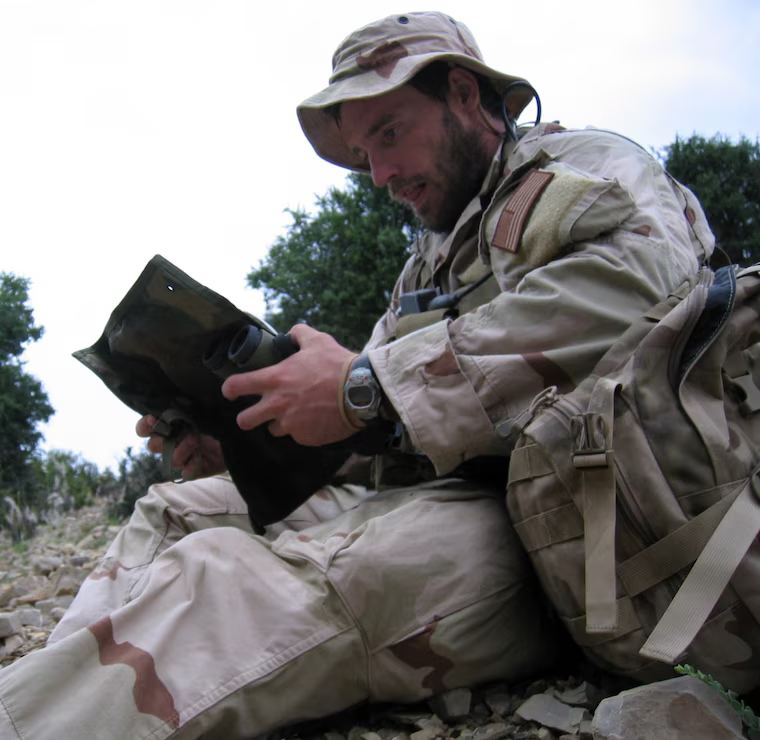
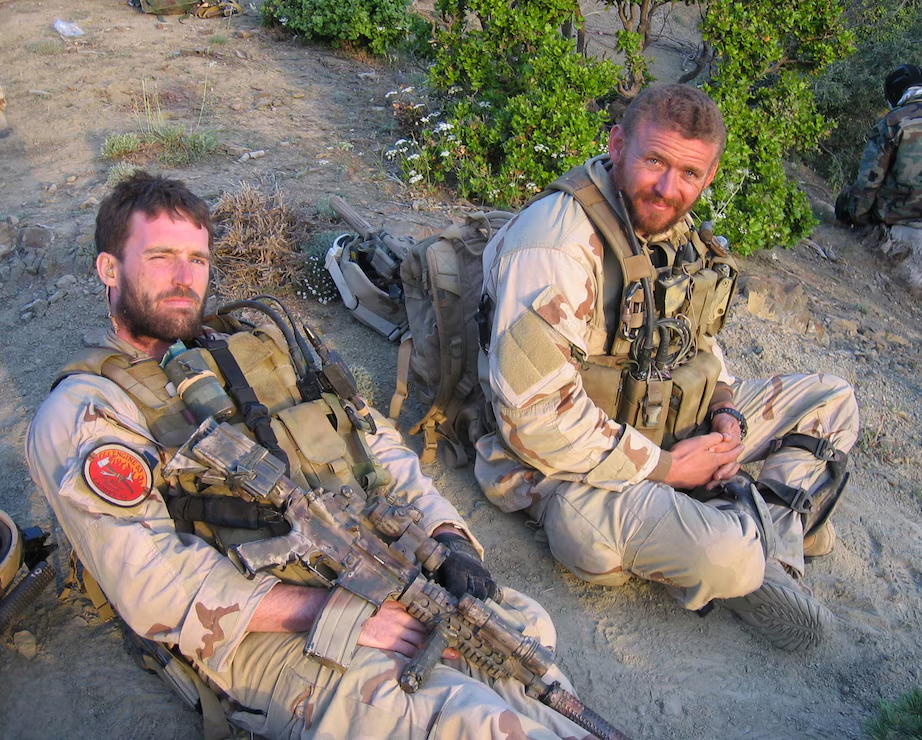
U.S. Navy photos.
Operation Red Wings · June 28, 2005
Deep behind enemy lines east of Asadabad, in the Hindu Kush at roughly 10,000 feet, Lt. Murphy led a four-man reconnaissance team — Danny Dietz, Matthew Axelson and Marcus Luttrell — scouting a militia leader named Ahmad Shah. Shortly after inserting, the team was spotted by local goat herders, who were detained and then released. Their position was reported to the Taliban.
A fierce firefight erupted against a far larger force holding the high ground on three sides. Forced deeper into a ravine, all four men were wounded. When the team's radio operator was shot before he could call for help, Murphy — already gravely wounded — deliberately moved into the open, away from the cover of the rocks, to get a signal. Under direct fire he reached the Quick Reaction Force at Bagram, calmly gave his position and the size of the enemy force, and asked for support. Shot in the back mid-call, he dropped the transmitter, picked it up, finished the call, and returned to his men to keep fighting.
The MH-47 Chinook sent to extract them, carrying eight SEALs and eight Army Night Stalkers, was struck by a rocket-propelled grenade as it approached. All sixteen aboard were killed. On the ground, by the end of a two-hour battle across the hills and cliffs, Murphy, Dietz and Axelson had fallen. Luttrell, blown over a ridge by an RPG and badly injured, evaded the enemy for nearly a day before local villagers took him in and refused to hand him over. He was rescued on July 2.
Murphy's call — made at the cost of his own cover and, ultimately, his life — is what led to Luttrell's rescue and the recovery of his teammates. It was the largest single loss of life for Naval Special Warfare since World War II.
Medal of Honor citation
Presented posthumously to his parents by President George W. Bush at the White House on October 22, 2007.
For conspicuous gallantry and intrepidity at the risk of his life above and beyond the call of duty as the leader of a special reconnaissance element with Naval Special Warfare Task Unit Afghanistan on 27 and 28 June 2005. While leading a mission to locate a high-level anti-coalition militia leader, Lieutenant Murphy demonstrated extraordinary heroism in the face of grave danger in the vicinity of Asadabad, Konar Province, Afghanistan. On 28 June 2005, operating in an extremely rugged enemy-controlled area, Lieutenant Murphy's team was discovered by anti-coalition militia sympathizers, who revealed their position to Taliban fighters. As a result, between 30 and 40 enemy fighters besieged his four-member team. Demonstrating exceptional resolve, Lieutenant Murphy valiantly led his men in engaging the large enemy force. The ensuing fierce firefight resulted in numerous enemy casualties, as well as the wounding of all four members of the team. Ignoring his own wounds and demonstrating exceptional composure, Lieutenant Murphy continued to lead and encourage his men. When the primary communicator fell mortally wounded, Lieutenant Murphy repeatedly attempted to call for assistance for his beleaguered teammates. Realizing the impossibility of communicating in the extreme terrain, and in the face of almost certain death, he fought his way into open terrain to gain a better position to transmit a call. This deliberate, heroic act deprived him of cover, exposing him to direct enemy fire. Finally achieving contact with his headquarters, Lieutenant Murphy maintained his exposed position while he provided his location and requested immediate support for his team. In his final act of bravery, he continued to engage the enemy until he was mortally wounded, gallantly giving his life for his country and for the cause of freedom. By his selfless leadership, courageous actions, and extraordinary devotion to duty, Lieutenant Murphy reflected great credit upon himself and upheld the highest traditions of the United States Naval Service.
His other awards include the Purple Heart, Combat Action Ribbon, Joint Service Commendation Medal, Navy and Marine Corps Commendation Medal, Afghanistan Campaign Ribbon and National Defense Service Medal. He is buried at Calverton National Cemetery, less than 20 miles from his childhood home. The guided-missile destroyerUSS Michael Murphy (DDG 112) carries his name.
The nineteen
Nineteen Americans died on June 28, 2005 — three SEALs on the mountain, and eight SEALs and eight Army Night Stalkers aboard the helicopter that came for them.
SEAL Delivery Vehicle Team 1, Pearl Harbor, Hawaii
- Lt. (SEAL) Michael P. Murphy, 29, of Patchogue, N.Y.
- Sonar Technician (Surface) 2nd Class (SEAL) Matthew G. Axelson, 29, of Cupertino, Calif.
- Machinist Mate 2nd Class (SEAL) Eric S. Patton, 22, of Boulder City, Nev.
- Senior Chief Information Systems Technician (SEAL) Daniel R. Healy, 36, of Exeter, N.H.
- Quartermaster 2nd Class (SEAL) James Suh, 28, of Deerfield Beach, Fla.
SEAL Delivery Vehicle Team 2, Virginia Beach, Va.
- Gunner’s Mate 2nd Class (SEAL) Danny P. Dietz, 25, of Littleton, Colo.
SEAL Team 10, Virginia Beach, Va.
- Chief Fire Controlman (SEAL) Jacques J. Fontan, 36, of New Orleans, La.
- Lt. Cmdr. (SEAL) Erik S. Kristensen, 33, of San Diego, Calif.
- Electronics Technician 1st Class (SEAL) Jeffery A. Lucas, 33, of Corbett, Ore.
- Lt. (SEAL) Michael M. McGreevy Jr., 30, of Portville, N.Y.
- Hospital Corpsman 1st Class (SEAL) Jeffrey S. Taylor, 30, of Midway, W.Va.
3rd Battalion, 160th Special Operations Aviation Regiment (Airborne), Hunter Army Air Field, Ga.
- Staff Sgt. Shamus O. Goare, 29, of Danville, Ohio
- Chief Warrant Officer Corey J. Goodnature, 35, of Clarks Grove, Minn.
- Sgt. Kip A. Jacoby, 21, of Pompano Beach, Fla.
- Sgt. 1st Class Marcus V. Muralles, 33, of Shelbyville, Ind.
- Maj. Stephen C. Reich, 34, of Washington Depot, Conn.
- Sgt. 1st Class Michael L. Russell, 31, of Stafford, Va.
- Chief Warrant Officer Chris J. Scherkenbach, 40, of Jacksonville, Fla.
HQ Company, 160th Special Operations Aviation Regiment (Airborne), Fort Campbell, Ky.
- Master Sgt. James W. Ponder III, 36, of Franklin, Tenn.